
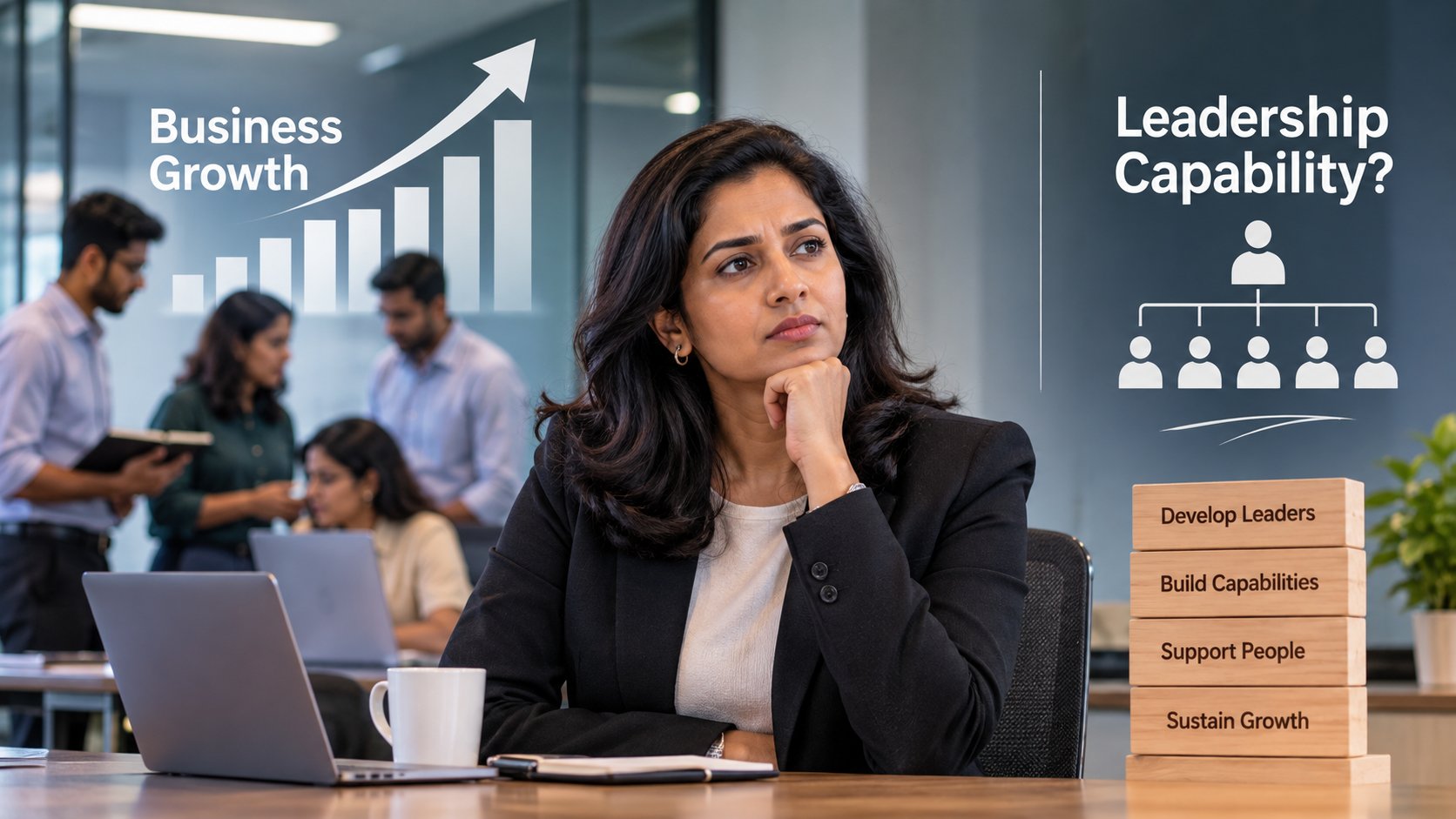
Kavitha, the founder of a logistics company, had built a business that was growing faster than she had initially imagined.
In just five years, her organisation had expanded from a team of twelve to 240 employees. New clients were coming on board at an unprecedented pace, revenue had doubled twice in three years, and every external indicator suggested a business that was performing exceptionally well.
Yet, beneath this growth story, a different reality was beginning to emerge.
Projects were missing deadlines that had once been comfortably managed. Communication between teams was becoming increasingly difficult. Managers who had performed exceptionally well when leading smaller teams were now responsible for significantly larger departments and struggling to meet the demands of their expanded roles.
At the same time, talented employees were beginning to ask questions about career progression and development, questions that the organisation was not yet equipped to answer consistently.
The business had grown. Its operational demands had evolved. But the leadership capability required to support this next stage of growth had not developed at the same pace.
This is a challenge many growing organisations encounter. Business expansion creates new opportunities, but it also introduces a level of organisational complexity that existing leadership structures may not be equipped to manage.
Growth is not simply about increasing revenue, expanding teams or acquiring new clients. It is also about developing the leadership capacity required to sustain that growth.
Growth Creates Leadership Demand Faster Than Organisations Build Capability
One of the less visible challenges of rapid business expansion is the growing demand for leadership at every level of the organisation.
A business with twelve employees may function effectively with a founder and a small management team. As that business grows to 240 employees, the leadership requirements change considerably.
The organisation now needs capable team leaders, functional managers, department heads and senior leaders who can manage complexity, make informed decisions, develop people and maintain alignment with business objectives.
These capabilities cannot be built overnight.
Yet, in many growing organisations, leadership development happens reactively. New positions are created when the business needs them, and people are expected to adapt to their responsibilities as they go along.
The result is often a leadership structure that expands in numbers without necessarily developing the depth of capability required to support the organisation.
The Best Individual Contributors Become First-Time Leaders
One of the most common consequences of rapid organisational growth is the promotion of high-performing individual contributors into management positions.
In Kavitha's organisation, several of the employees who had contributed significantly to its early success had gradually moved into managerial roles. They were familiar with the business, understood its operations and had demonstrated strong individual performance.
Promoting them was a natural decision.
However, the transition from being an effective individual contributor to becoming an effective people manager requires a fundamentally different set of capabilities.
Technical expertise, functional knowledge and individual performance do not automatically translate into the ability to lead others.
Managing larger teams, setting expectations, conducting development conversations, providing constructive feedback, navigating conflict and building accountability require deliberate preparation.
Gallup's research indicates that only 18 per cent of managers demonstrate a high level of natural talent for managing others. This reinforces the importance of identifying leadership potential and developing the capabilities required to succeed in management roles.
The challenge is not that organisations promote the wrong people. It is that they often promote capable people into new responsibilities without adequately preparing them for what those responsibilities demand.
The Impact of Leadership Gaps Appears in People Before It Appears in Business Performance
Leadership capability gaps rarely become visible in financial reports immediately. Their effects tend to emerge gradually through everyday organisational experiences.
Employee engagement begins to decline when managers struggle to provide direction and support. Communication becomes inconsistent as teams and reporting structures expand. Performance expectations become less clear, and employees may find themselves working without sufficient guidance or feedback.
Career development is another area that often gets affected.
Employees who join a growing organisation naturally expect opportunities to learn, take on greater responsibilities and progress in their careers. However, as the organisation expands, these expectations require more structured development conversations, clearer progression pathways and managers who can actively support employee growth.
When these systems are not in place, the organisation risks losing the very talent that contributed to its early success.
There is an important distinction here. Business growth increases the number of people, but it also increases the complexity of managing their expectations, capabilities and contributions.
The people impact of inadequate leadership development often becomes visible long before its full business impact is reflected in performance metrics.
Organisations that recognise these early signals are better positioned to address capability gaps before they begin affecting business continuity, productivity and growth.
What Organisations Need to Do Differently
Kavitha's story has a different trajectory once she recognises that the challenges facing her organisation are not simply operational issues, but symptoms of a larger leadership capability gap.
Instead of addressing individual problems in isolation, she begins looking at how effectively her managers are equipped to lead the organisation through its next stage of growth.
The focus shifts towards building leadership capability in a structured and sustained manner.
While the specific interventions will vary depending on the organisation, there are a few areas that deserve particular attention.
- Develop Leadership Capability Before the Need Becomes Urgent
Leadership development should not begin only when managers start struggling with their responsibilities.
Organisations need to anticipate the leadership capabilities they will require as they grow and prepare their people accordingly.
This includes developing skills in people management, communication, decision-making, coaching, delegation, conflict management and performance conversations.
A structured approach ensures that managers are better prepared to handle the increasing complexity of their roles.
- Prepare High Performers for the Transition into Leadership
Being a high performer does not necessarily mean being ready to manage a team.
Organisations need to recognise this distinction and provide first-time managers with the guidance, frameworks and practical exposure required to make this transition successfully.
The focus should move beyond technical and functional expertise towards the ability to develop people, build accountability and create an environment in which teams can perform effectively.
- Build a Consistent Leadership Approach Across the Organisation
As organisations expand, individual managers often develop their own ways of leading teams.
While some flexibility is important, the absence of a shared leadership approach can create inconsistencies in communication, performance management, employee development and decision-making.
Establishing common leadership principles and expectations helps create greater alignment across functions and levels.
It also ensures that the employee experience does not depend entirely on which manager they happen to report to.
- Make Employee Development a Managerial Responsibility
Employee development cannot remain an isolated HR initiative.
Managers play a critical role in identifying potential, understanding development needs, providing feedback and creating opportunities for employees to take on greater responsibilities.
Organisations need to equip managers to have meaningful career conversations and support individual growth while maintaining alignment with business priorities.
This is particularly important in growing organisations, where retaining and developing existing talent can be as important as hiring new people.
- Treat Leadership Development as a Continuous Investment
Leadership capability is not developed through a one-time training intervention.
It requires continuous learning, practical application, feedback and reinforcement.
Organisations need to create development opportunities that reflect the actual challenges managers face in their roles. Experiential learning, coaching, peer discussions and workplace application can help managers translate learning into everyday leadership practices.
The objective is not simply to expose managers to new concepts, but to strengthen the way they lead, make decisions and develop their teams.
Scaling a Business Requires Scaling Leadership Capability
As organisations grow, their leadership requirements change. What worked when a business had twelve employees may no longer be sufficient when it has 240. The structures, processes and management capabilities that supported the early stages of growth must evolve to support what comes next.
This requires leadership development to become an integral part of business planning rather than a reactive response to emerging challenges.
At Concordia Enabling Solutions, we work with organisations to build leadership capability through structured, practical and relevant learning experiences. Our focus is on helping leaders navigate the real challenges of managing people, strengthening teams and leading organisations through different stages of growth.
Because sustainable growth is not determined by how quickly an organisation expands, but by how effectively it develops the people and leadership capabilities needed to support that expansion.
The organisations that scale successfully are not necessarily the ones that grow the fastest. They are the ones that ensure their leadership capability grows alongside their business.