
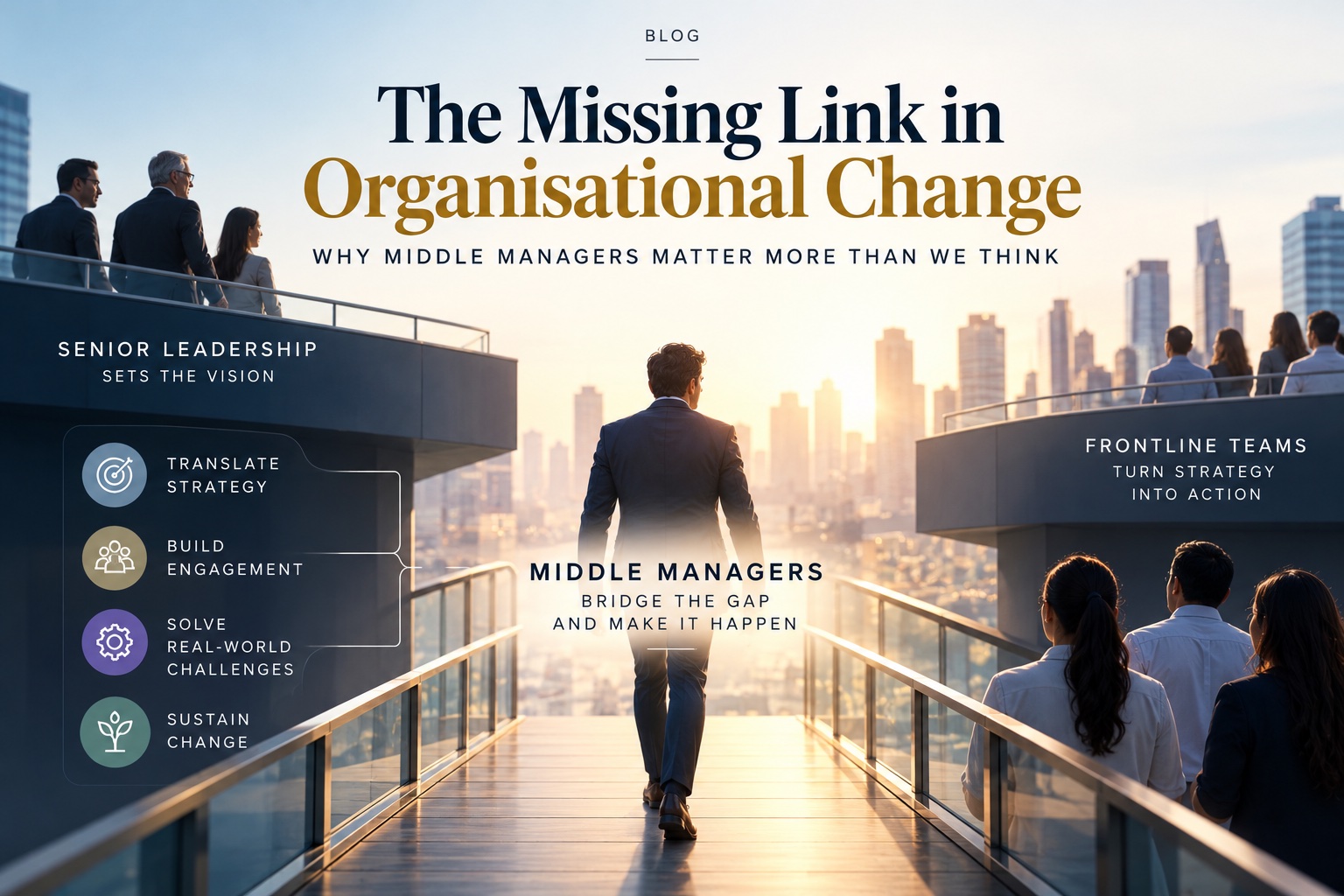
When organisations embark on change, whether it is digital transformation, restructuring or a shift in organisational culture, the spotlight naturally falls on senior leadership. They are expected to define the vision, set the direction and articulate the strategic intent.
But a strategy, however compelling, does not create change on its own. Its success depends on how effectively it translates into everyday decisions, behaviours and ways of working.
This is where middle managers play a critical role.
Simon Sinek, author and inspirational speaker, has often highlighted the complexity of the middle management role. Middle managers operate at the intersection of strategic expectations and operational realities. They are accountable for business performance, expected to lead and develop their teams, and responsible for maintaining engagement and morale, often while navigating competing priorities and limited resources.
Yet, despite the complexity of this role, organisations frequently promote high-performing individual contributors into management positions without adequately preparing them for the transition. Many middle managers are left to develop their leadership capabilities through experience, observation and trial and error.
The irony is difficult to ignore. Organisations expect middle managers to lead people through change, often without investing sufficiently in the very capabilities that make this possible.
While senior leadership focuses on strategy, business performance and quarterly outcomes, the development of the middle management layer can become a secondary priority. In doing so, organisations risk overlooking one of the most influential determinants of successful change.
Middle managers do not merely implement change. They translate it, contextualise it, challenge it when necessary, and make it real for the people expected to adopt it.
They are also an important source of feedback for senior leadership, bringing visibility to operational realities that may not be apparent in boardroom discussions or transformation dashboards.
In many ways, they are the connective tissue between organisational ambition and execution.
###Why Middle Managers Are Critical to Change
- Bridging Strategy and Execution
Senior leaders define the direction of change. Middle managers translate that direction into operational priorities, team-level expectations and measurable actions.
A strategy to become more customer-centric, for instance, requires much more than a communication campaign or a revised set of organisational values. It requires managers to help employees understand what customer-centricity means in their daily interactions, decision-making and problem-solving.
Similarly, a digital transformation initiative requires managers to address practical questions: How will workflows change? What capabilities will employees need? What happens when the new system does not accommodate an existing operational requirement?
Without this translation, strategy remains an aspiration rather than an organisational capability.
Middle managers bridge this gap by connecting the why of change with the what and how of execution.
- Building Trust and Driving Employee Engagement
Change rarely fails because people have not received an announcement. It often struggles because people do not fully understand the rationale, do not trust the process, or do not feel equipped to navigate what is expected of them.
This is where the quality of the immediate manager relationship becomes particularly important.
Middle managers understand their teams, their concerns and the realities of their working environment. They are better positioned to recognise resistance that stems from uncertainty, capability gaps, competing priorities or a genuine concern about how the change will affect performance.
Their role is not simply to communicate decisions made elsewhere. It is to create the conditions in which people can understand, question and gradually engage with those decisions.
Employees may hear the strategy from the CEO, but they often make sense of what it means for them through conversations with their managers.
In this context, middle managers become the human face of organisational change. Their credibility, communication and ability to listen can influence whether employees experience change as something being imposed on them or something they can participate in shaping.
- Sustaining Change Beyond the Launch
Launching a change initiative is a milestone. Embedding it into the organisation is the real achievement.
New processes, technologies and operating models do not become sustainable simply because they have been introduced. They require consistent reinforcement, coaching, feedback and accountability.
Middle managers are central to this process.
They observe whether new behaviours are being adopted, identify where employees are struggling, reinforce desired practices and address the everyday pressures that can pull teams back towards familiar ways of working.
They also carry valuable contextual knowledge about team dynamics, informal networks and organisational culture. This insight helps them identify what needs to change in the implementation approach to make the desired outcomes sustainable.
Ultimately, transformation is not complete when a new process goes live. It is complete when the new way of working becomes part of how the organisation operates.
And that transition is significantly influenced by the quality of middle management.
The Paradox: High Expectations, Limited Support
If middle managers are so critical to organisational change, why do so many organisations continue to underinvest in their development?
One explanation lies in the way the role has evolved.
Middle managers are frequently expected to deliver business results, manage operational complexity, lead people, communicate strategic priorities and support transformation, all at the same time. Administrative demands, meetings and reporting requirements often leave them with limited time for the work that matters most: leading people.
McKinsey's analysis of middle management has highlighted how administrative burdens and organisational inefficiencies can prevent managers from making full use of their capabilities.
Other research points to gaps in leadership preparation and organisational support. Simon Sinek, for example, has drawn attention to the reported lack of essential leadership skills among middle managers and the absence of structured development opportunities in many organisations.
These findings point to a fundamental organisational issue.
We expect middle managers to deliver leadership outcomes without always treating leadership as a capability that must be deliberately developed.
The consequences extend beyond individual managers.
When managers lack clarity, confidence or the skills required to lead through uncertainty, employees receive inconsistent messages. Concerns go unaddressed, implementation becomes uneven, and resistance can be misinterpreted as unwillingness rather than a signal that something in the change process needs attention.
In such situations, organisations may attribute poor adoption to employee resistance when the underlying issue could be inadequate communication, insufficient capability development or a disconnect between the strategy and operational realities.
The cost is not merely human. It is operational and financial.
A transformation programme can have a sound business case, strong executive sponsorship and substantial technology investment, yet still struggle to deliver its intended outcomes because the people responsible for translating the change into practice have not been adequately equipped to do so.
###An Indian Banking Context: When Ground-Level Insight Shapes Transformation
Consider a large Indian private sector bank undertaking a customer service transformation across approximately 4,500 branches.
The initiative introduces new digital workflows and service protocols, with the expectation that the changes will improve customer experience and standardise service delivery.
However, the initial rollout encounters difficulties. Frontline employees find some procedures confusing and time-consuming. Customer complaints increase, and adoption begins to fall short of expectations.
The issue is not necessarily the strategic intent. The challenge lies in translating that intent into a workable operating model across diverse branch environments.
Regional and cluster-level managers begin escalating structured feedback. They highlight gaps between the training material and actual branch conditions, as well as workflow requirements that do not adequately account for local customer behaviour.
Instead of treating these concerns as resistance to change, leadership brings a cross-functional group of middle managers into the redesign process.
The managers contribute by simplifying communication scripts, recommending practical adjustments to digital workflows, participating in pilot testing and supporting peer-led learning for other managers.
Over the following four months, customer satisfaction improves, adoption stabilises and the revised model is adopted more widely across the organisation.
The significance of this example lies in the role played by middle management. The managers were not simply responsible for executing a decision. They helped identify implementation gaps, connect frontline experience with strategic intent and improve the solution itself.
Note: This is an illustrative, anonymised case scenario. It should not be presented as a verified organisational case study unless the underlying source and outcome data can be substantiated.
###The lesson is relevant well beyond banking.
Transformation becomes more effective when organisations create mechanisms for ground-level insight to inform decision-making. Middle managers are often best placed to identify the gap between what appears workable in a strategic presentation and what is practical in the operating environment.
Their involvement is not a concession to resistance. It is an investment in better execution.
###What Organisations Need to Rethink
If organisations want to improve the success of their transformation initiatives, middle management development must move from the periphery of the change agenda to its centre.
This requires more than a series of leadership workshops. It calls for a deliberate shift in how organisations prepare, support and involve their managers.
- Build Leadership Capability Before It Becomes a Business Risk
Technical expertise and individual performance do not automatically translate into the ability to lead people.
Middle managers need structured development in communication, coaching, emotional intelligence, conflict management, decision-making and change leadership. They must learn to navigate uncertainty, address concerns constructively and help their teams adapt without losing sight of business priorities.
Leadership development should not be viewed as a reward for promotion. It should be an integral part of preparing people for the responsibilities they are expected to assume.
- Involve Middle Managers Early in the Change Process
When managers are brought into the conversation only after decisions have been finalised, their role becomes largely transactional: communicate the decision, manage the response and deliver the outcome.
Early involvement creates a different dynamic.
Managers can test assumptions, identify operational constraints, anticipate employee concerns and contribute to implementation planning. Their participation can also improve their own understanding of the change, enabling them to communicate its rationale with greater clarity and conviction.
Co-creation does not mean that every decision must be made by consensus. It means that decisions benefit from the insight of those responsible for translating them into practice.
- Give Managers the Time and Space to Lead
Organisations cannot expect managers to prioritise people development while continuously filling their calendars with administrative work and review meetings.
It is worth examining which activities genuinely require managerial attention, which can be simplified and which add limited value.
Reducing unnecessary bureaucracy creates space for coaching, feedback, problem-solving and team engagement.
If people leadership is a business priority, organisational systems must make time for it.
- Establish Two-Way Communication
Middle managers should not be treated merely as channels through which information flows from the top down.
They are equally important sources of information flowing upwards.
Organisations need structured mechanisms through which managers can report implementation barriers, share employee feedback and challenge assumptions constructively. Senior leaders, in turn, must demonstrate that this feedback is heard and acted upon where appropriate.
When managers see that speaking up leads to meaningful consideration, they are more likely to surface issues early, before they become larger implementation problems.
- Recognise and Measure Their Contribution
Middle managers are often assessed primarily on business results, delivery timelines and operational metrics. These measures matter, but they do not capture the full extent of their contribution to transformation.
Organisations should also consider indicators such as employee capability development, adoption of new practices, team engagement, quality of feedback and the sustainability of behavioural change.
Recognition must reflect the role managers play in enabling others to succeed, not merely their ability to deliver results through personal effort.
- Make People Leadership a Professional Discipline
Perhaps the most important shift is conceptual.
Managing people is often treated as a natural extension of being a good performer. In reality, it is a distinct professional capability that requires knowledge, practice, feedback and continuous development.
The ability to understand human behaviour, communicate with empathy, navigate difficult conversations and influence behaviour is not incidental to business performance. It is fundamental to it.
This is particularly true during periods of change, when uncertainty increases, familiar routines are disrupted and employees look to their immediate leaders for clarity and direction.
Organisations that recognise this will be better positioned to build managers who can deliver results while strengthening the people and systems responsible for those results.
###The Leadership Question We Need to Ask.
As organisations invest in transformation strategies, new technologies and operating models, there is a question worth asking:
Are we investing as deliberately in the people who must make these changes work as we are in the changes themselves?
The answer has significant implications for organisational effectiveness.
Senior leadership provides direction, establishes priorities and creates the conditions for change. But the quality of execution depends on how effectively that direction is understood, translated and reinforced across the organisation.
Middle managers operate at this intersection. They connect strategy with people, business priorities with operational realities, and organisational ambition with everyday behaviour.
They are also uniquely positioned to tell leadership when a plan needs to be reconsidered, not because the vision is wrong, but because the path to achieving it needs to be rethought.
Recognising their contribution requires more than acknowledging that they are important. It requires organisations to equip them with the capabilities, authority, time and support needed to fulfil their role.
At Concordia Solutions, we believe that change lives or dies in the middle layer. Sustainable transformation requires more than a compelling vision and a well-designed implementation plan. It requires managers who understand the human dimensions of change and have the capability to translate strategic intent into meaningful, sustained action.
When organisations invest in their middle managers, they strengthen far more than one layer of leadership. They strengthen the connection between strategy, people, culture and performance.
Middle managers are not simply implementers of change. They are translators of strategy, builders of trust, connectors of insight and stewards of progress.
It is time we stopped treating them as the layer between leadership and execution and started recognising them as a critical leadership force in their own right.